
Supercapacitor Charging Application Solutions— NSP-1000 Series
Technical Service Center / Willard Wu
willard@meanwell.com
In recent years, with the rapid development of industries such as AI data centers, smart manufacturing, automated logistics, rail transportation, renewable energy, and smart grids, systems have seen a continuously increasing need for instantaneous high-power output, short-term backup, and high-frequency charge/discharge cycles. While traditional batteries offer relatively high energy density, they still have limitations in fast charge/discharge, high-rate output, and cycle life. As a result, supercapacitors, which combine high power density with an extremely long service life, have gradually become an important energy storage component for many industrial devices.
The greatest characteristic of supercapacitors is their ability to charge and discharge rapidly. Compared to lithium batteries, which typically take tens of minutes or even hours to charge, supercapacitors can complete charging within seconds to minutes and can release large amounts of energy in a very short time, making them highly suitable as instantaneous power compensation or short-term backup power sources. In addition, the charge/discharge cycle life of supercapacitors can reach several hundred thousand to over a million cycles, far exceeding that of general batteries, making them especially suitable for industrial applications requiring frequent charge/discharge cycles.
However, after each discharge, the terminal voltage of a supercapacitor may drop to near 0V; meaning the charger must start charging from nearly 0V each time, rather than retaining a residual voltage as lithium batteries do. When a power supply is directly connected to a low-voltage supercapacitor, the extremely large voltage difference can, without proper current control, instantly produce a very large inrush current, potentially triggering the power supply's overcurrent protection and preventing normal charging. Furthermore, in addition to providing sufficient output power, a supercapacitor charging power supply must, more importantly, feature low-voltage output capability, stable constant-current control and the ability to operate for extended periods in constant-current mode to complete charging safely and efficiently.
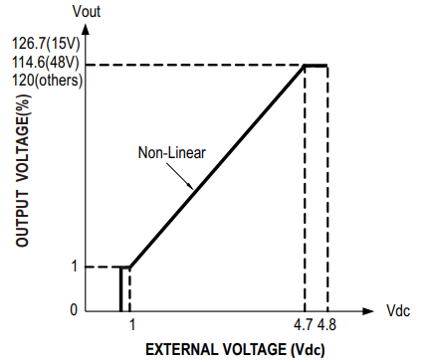
To address the application needs of supercapacitors and high-power energy storage devices, MEAN WELL has newly launched the NSP-1000 series digital AC/DC power supply. In addition to high efficiency, high power density, and complete digital control functions, it is also equipped with the brand-new PV function(Figure 1), which can adjust the output voltage to an extremely low voltage range, breaking through the minimum output voltage limitation of typical industrial power supplies.
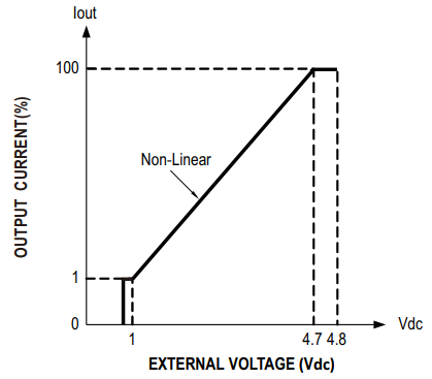
For supercapacitors, the greatest advantage of the NSP-1000 series PV function is that it can begin operating at an output voltage close to 0V, and then gradually increase the output voltage according to the set value. Combined with PC function control(Figure 2), this keeps the charging process stable and predictable, preventing the protection mechanism from being triggered by the high current demand at the start of charging.
In addition, the NSP-1000 series also supports digital communication interfaces such as CANBus, allowing integration with PLC, EMS, or BMS systems. This enables real-time software adjustment of output voltage and charging current, as well as monitoring of output status, fault information, and operating parameters, providing greater flexibility for system integration.
For related products and application needs, please contact MEAN WELL distributors or technical personnel directly, and stay tuned to MEAN WELL's online exhibition hall for related products and solution courses.
